Lowborough’s vows of abstinence
The Tenant of Wildfell HallLowborough’s vows of abstinence are a recurring struggle rather than one decisive promise. He swears to give up gambling and later declares that he will renounce drink, but those public commitments are followed by lapses, concealment, and renewed attempts at reform. Through the contrast between his sincere distress and the company that repeatedly tempts him, the vows expose the fragile boundary between personal resolve and an enabling social environment.
Gambling and the oath
Lowborough’s gambling has become compulsive despite his repeated intentions to stop. Each wager seems to justify another: a small gain encourages him to seek more, while a loss makes him feel he must continue until he has recovered it. The cycle turns every outcome into a reason not to leave the gaming table, so that the resolve to quit is continually postponed by the hope that the next attempt will be different.
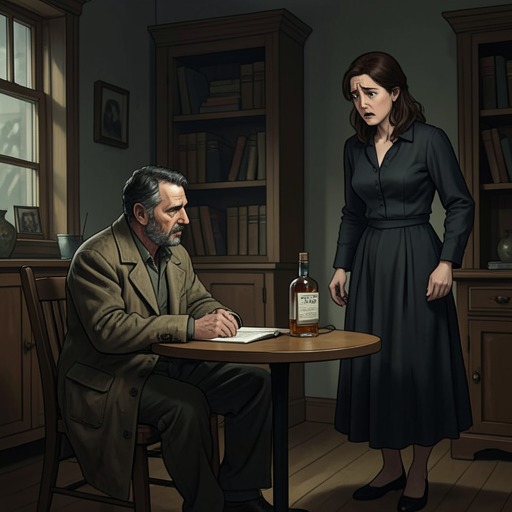
At one such moment, Gilbert Markham finds him standing with folded arms and his eyes fixed on the ground. Asked whether this is to be his last venture, Lowborough answers that it is the last but one. He then returns to the table, raises his voice above the room’s commotion, and swears that this trial will be his last, invoking a curse on himself if he ever handles cards or dice again. The oath is emphatic, but its immediate setting makes its weakness plain: having just vowed to stop, he doubles his stake and challenges someone to play.
Grimsby takes up the challenge, and Lowborough loses. The episode frames the oath as a sincere but unstable attempt to interrupt a cycle that has already taught him to reinterpret every loss as a reason to continue. The phrase last but one, followed by a solemn declaration of finality, makes the gap between intention and action part of the scene itself.
From gambling to drink
Lowborough keeps his gambling oath, to the surprise of his companions, even as Grimsby does his best to tempt him back. Yet abstaining from play does not bring an end to his troubles. He takes to drinking to console himself, and the narrative describes the new habit as nearly as hard for him to escape as gambling had been. The change suggests not that his earlier resolve was meaningless, but that abandoning one source of dependence leaves him vulnerable to another.
His renunciation of alcohol also takes place among companions who make a spectacle of it. When Gilbert urges him to taste his wine, Lowborough calls it poison, says that he has given up gambling and will give up drink as well, and appears ready to pour out the bottle. Hargrave takes the bottle from him; Lowborough withdraws, bidding farewell to the tempters. The group responds with laughter and applause, turning a personal effort at abstinence into a performance for its amusement.
For a week, Lowborough does not return to their gathering places, and his companions begin to think he may keep his word. His absence offers a brief measure of hope, but it does not establish lasting sobriety. Later, Gilbert knows that Lowborough keeps laudanum privately and uses it unevenly, alternating restraint with excess as he does with spirits. The private bottle complicates the public appearance of abstinence: avoiding drink in one setting does not mean that the underlying pattern of dependence has ended.
Resolve under social pressure
The narrative makes Lowborough’s surroundings part of the problem. His companions repeatedly encourage indulgence, and Grimsby specifically tries to draw him back to gambling after he has sworn it off. When Lowborough attempts to reform, his recollection is that Huntingdon had kept him from doing so, while his own dependence on their company had made separation difficult. His explanation presents abstinence not as an isolated test of character but as a struggle against both habit and the relationships that sustain it.
Lowborough eventually grasps Huntingdon’s arm and insists that he is resolved to have done with his old life. When Huntingdon suggests that reform is nothing new, Lowborough acknowledges that he has announced it before. This time, however, he identifies the influence holding him back and says that he would go to great lengths to obtain what he believes he needs to be saved, though he fears there is no chance. The scene gives the vows a more reflective form: instead of another declaration made at a gaming or drinking table, it is an admission that willpower alone has not freed him from a destructive attachment.
Meaning and limits of the vows
Lowborough’s record distinguishes a maintained promise from a completed recovery. He does keep the oath against gambling, even under pressure from Grimsby, but the narrative also records his turn to alcohol and his concealed, inconsistent use of laudanum. His later resolve to reform recognizes the continuing force of his habits and his dependence on Huntingdon’s company. The sequence therefore resists treating abstinence as a single public pledge that settles the matter.
The vows also give the surrounding men a measure of responsibility. Their laughter, applause, and repeated invitations make Lowborough’s attempts at change vulnerable to ridicule and temptation, while his own admission that he could not live without Huntingdon shows how social attachment can obstruct the very reform he desires. His promises matter, but their uneven consequences reveal the difference between declaring a boundary and sustaining it within an environment organized around excess.